Finger injuries in climbing: when to cut the load
How to spot finger overload in your athletes, when to reduce training load and how to build it back without repeating the injury. A practical guide for coaches.
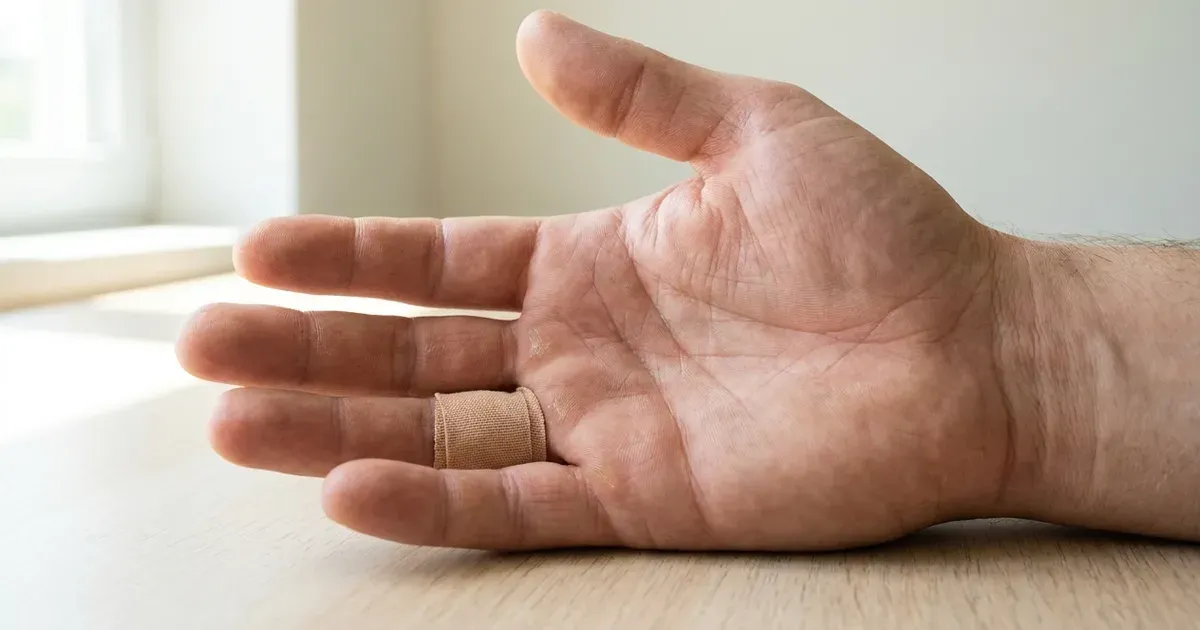
Almost no finger injury shows up out of nowhere. It shows up after three weeks of high volume, a change of grip type, a holiday followed by an over-ambitious comeback, or an athlete who spent a month saying “it’s a bit sore” without anyone writing it down.
In hindsight, most climbing finger injuries are predictable. The problem is not an absence of signals: it is that the signals are scattered across a WhatsApp message, a session the athlete quietly didn’t finish, and a test that dropped 7% that nobody compared.
This guide is about what a coach can do with that: which signals to watch, when to cut load, how much, and how to build it back.
First: where your job ends
Diagnosis is not the coach’s job. Sharp pain, an audible pop, swelling, sudden strength loss, or pain that wakes the athlete at night all mean refer to a physiotherapist or doctor with climbing experience - not tweak the plan and hope.
What is your job, and nobody else will do it:
- Spot the drift before it becomes an injury.
- Modulate load when a niggle appears.
- Record all of it so it is still readable in six months.
- Run the return to load that the clinician authorises, which is almost always described vaguely (“build up gradually”) and which somebody has to translate into kilos and sets.
The rest of this article is about those four things.
What actually breaks, in one page
Not so you can diagnose, but so you understand what you are loading and why some plan decisions are more aggressive than others.
Annular pulleys (A2 and A4). The bands holding the flexor tendon against the bone. The classic climber’s injury, and overwhelmingly associated with the full crimp, which multiplies tension on the A2 compared with a half crimp. Usually gives localised pain on the palm side of the phalanx, reproducible on pressure.
Flexor tendons and their sheaths. More diffuse, slower to develop, slower to resolve. Typical of accumulated volume rather than a single move.
Joint capsule and the interphalangeal joint. More of a “joint” pain, often with morning stiffness and mild swelling. Strongly associated with a lot of bouldering on slopers and pockets.
The practical consequence for planning is simple: grip type matters as much as kilos. Two athletes with identical load on paper can be getting very different stimulus if one crimps everything and the other doesn’t.
The five signals you can actually see
None of these is a diagnosis. All of them are a reason to look closer.
1. A regression in the strength test. A sustained drop in peak force, especially a one-sided one, is the cleanest signal you will get. This is why a fixed dynamometer testing protocol is worth the effort: without a baseline, a drop is invisible.
2. Growing asymmetry. A between-hands difference that moves from 5% to 12% across two blocks is not handedness. It is one side compensating for something.
3. A falling session completion rate. When an athlete starts leaving hangboard blocks half-done while still finishing the climbing ones, it is rarely motivation. Something hurts and they are avoiding the stimulus without saying so.
4. Niggles mentioned in passing. “It’s nothing, ring finger’s a bit tight.” Said in a message, with no date, no side, no severity. This gets lost 100% of the time if there is nowhere to record it.
5. Volume spikes. A sharp jump from what the athlete had been doing. The absolute number doesn’t matter; the jump does.
The load-jump rule
You don’t need a statistical model. The working version is:
Compare what the athlete did this week against the average of the previous four. If the jump is more than 30-40%, you added too much at once.
It is a heuristic, not a law - the evidence on acute:chronic workload ratios is contested and comes mostly from other sports. But it does the job you need: catching the step change you are going to regret.
Applied to fingers, all of this counts as load:
- Hangboard sets (number × intensity).
- Bouldering on small holds, pockets and slopers.
- Endurance routes on demanding holds.
- And yes, the weekend on real rock that isn’t in your plan.
That last one causes the most injuries. A flawless Monday-to-Friday plan plus three days projecting outdoors is not a flawless plan - it is a volume nobody is counting.
When to cut load, and how much
The decision isn’t binary. This is the scale that works in practice:
| Signal | What to do | Duration |
|---|---|---|
| Mild soreness on warm-up that fades once climbing | Record and watch. Drop full crimp. | 1 week |
| Soreness that persists through the session | Cut max hangs and pockets. Keep easy climbing. | 1-2 weeks |
| Soreness the next day | Cut all maximal finger stimulus. Low volume, big holds. | 2-3 weeks |
| Localised pain, reproducible on pressure | Stop finger stimulus and refer. | Until assessed |
| Sharp pain, a pop, swelling, strength loss | Stop. Refer today. | Until assessed |
Two things this table assumes, worth saying out loud:
Cutting load is not stopping. An athlete told to “rest for two weeks” comes back detrained, demotivated, and with exactly the same tissue capacity they had before. There is nearly always a reduced version of the stimulus that keeps the habit and the general condition: easy climbing on big holds, lower body work, core, mobility, technique on friendly holds.
Grip type is the first lever, not kilos. Before you drop intensity, drop full crimp and pockets. Plenty of early niggles resolve on that alone.
Building back without repeating it
The comeback is where injuries recur, because the athlete feels fine before the tissue is ready.
- Start below what the athlete thinks they can do. Once the clinician clears loading, start around 50-60% of their previous MVC, half crimp, short sets.
- Step up weekly, not per session. And only if the previous week passed with no next-day symptoms.
- Reintroduce the grip before the intensity. Get the crimp back at low load first, then raise the load.
- Re-test before signing off. If the affected side is still 10% down, the return block isn’t finished, even if nothing hurts.
- Count the weekend. The athlete will want their project back. That load goes in the total.
One rule that prevents relapses: if a symptom appears, drop back one step and stay there for two weeks, rather than stopping entirely and restarting from zero.
Where this fits in the season
Deloading shouldn’t be something you improvise when someone complains. A season structured in mesocycles already has a lighter week every three or four, and that week is the natural place to:
- Test without accumulated fatigue.
- Review the niggles logged during the block.
- Decide whether the next block progresses, holds or corrects.
An athlete arriving at the deload week with three logged niggles and growing asymmetry does not need the max-strength block you had planned. They need a different one. But you can only see that if those three niggles were logged somewhere.
What to record so none of this is guesswork
The minimum viable set, per athlete:
- The incident: start date, finger and hand, type of pain, which move provokes it.
- Progress: one note per week, even if it’s “same”. Sequences of “same, same, better, same” are what tell you whether it’s going well.
- The associated decision: what you changed in the plan and when. Without this, in three months you won’t know what worked.
- Discharge: when they returned to full load, and with what numbers.
- Load context: sessions completed, weekly volume and outdoor days.
With one athlete this fits in a notebook. With twelve, it is exactly where the spreadsheet starts to fail: the information exists but it is scattered, nobody cross-references it, and the signals become visible only once they are injuries. It is the same bottleneck that pushes many coaches to drop the spreadsheet.
The short version
- Most finger injuries are cumulative, and they leave a trail before they arrive.
- The useful signals are already in your data: tests, asymmetry, completed sessions, niggles, volume jumps.
- Drop the grip before the kilos, and reduce before you stop.
- Build back by weeks, not sessions, and close it with a test, not a feeling.
- Diagnosing isn’t your job. Spotting, modulating, recording and rebuilding the load is.
ClimbrLab is climbing coaching software, and it logs incidents per athlete with their progress and cross-references them against metrics and completed sessions, so the signals surface before they become injuries. We’re opening early access for coaches.
Keep reading
Shoulder and elbow: the climbing injuries you're not watching
The shoulder is now the second most injured area in climbing and almost never gets logged. Why it hides, which sign gives it away and what prevention works.
Rock climbing seasons in Europe: how they shape your planning
Siurana, Font, Céüse or Rodellar set your athlete's window better than any calendar. How to build a training year backwards from rock conditions.
Initial assessment of a climber: what to measure on day one
The screening questionnaire before taking on an athlete, which tests make a useful baseline, what not to test yet, and why protocol beats the number.
Do you coach climbing athletes?
ClimbrLab is software for climbing coaches who work with several athletes. You plan sessions and cycles, your athletes log workouts and routes from their app, and you see their finger strength (with Tindeq), training load, injuries and progress in one dashboard, with chat built in. If there are several coaches, Team mode lets you share a library and split athletes between you.
Tell us how you coach and we’ll get back to you with access.