Coaching climbers remotely without losing control
How to coach climbers online: what can be trained without seeing them, how to ask for a useful video, and which metrics replace the coach’s eye.
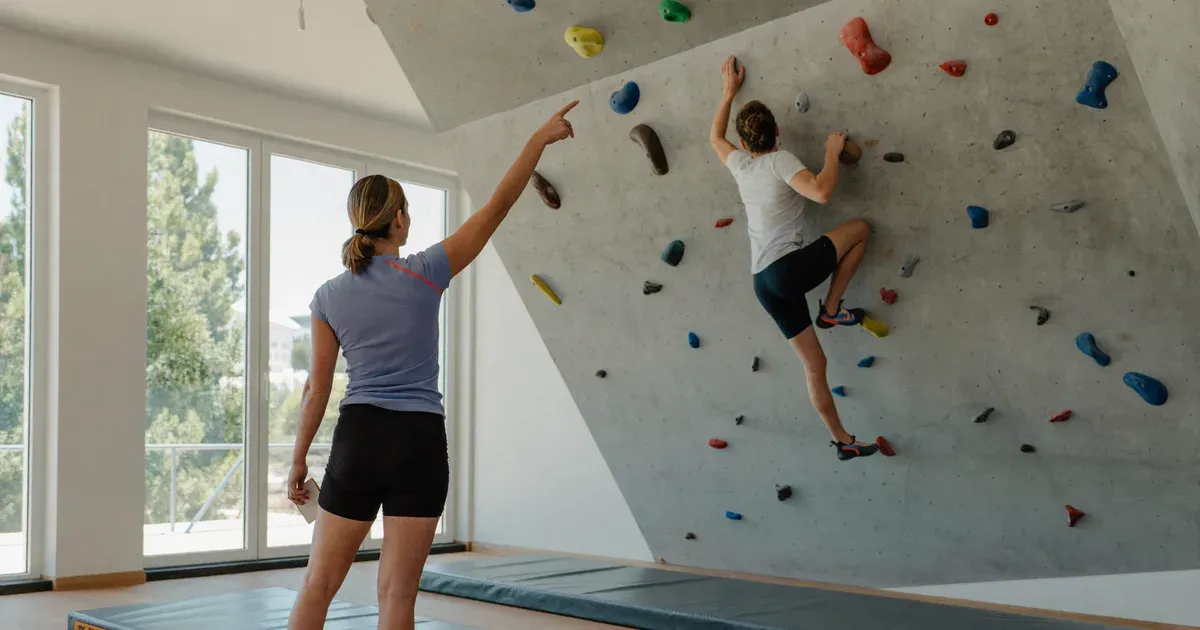
Coaching at a distance is not worse coaching: it is coaching with less information. A coach who shares a gym with their athlete sees the movement, the face, the chalk on the hand and the session falling apart before anyone says a word. Remotely, all of that disappears and only what the athlete reports is left.
The mistake is not taking on remote athletes. It is doing it without replacing the information you lose. This article is about exactly that: what disappears, what you replace it with, and which routine keeps the system alive past the three-month mark.
What works remotely, and what does not
Not everything degrades equally when you remove presence. An honest split:
| Trains well remotely | Needs presence (or nearly) |
|---|---|
| Finger strength and hangboard protocols | Fine footwork correction |
| General strength and gym work | Fall practice and confidence on the rope |
| Season structure and periodisation | On-the-spot route reading and project tactics |
| Volume, density and load control | Managing emotion in competition |
| Mobility, antagonists, prehab | The first weeks of a complete beginner |
The left column is most of the work for an intermediate or advanced climber. That is why online coaching works: what determines progress most is measurable and programmable. What cannot be coached remotely is not impossible, it just has to be concentrated into occasional in-person sessions or live video - not spread across every session.
Practical rule: if the athlete has been climbing for less than a year, pure remote is a bad idea. The bottleneck there is technical, and technique is exactly what travels worst through a screen.
Video feedback: how to ask for a usable clip
Video is the central tool of remote coaching and it is almost always used badly. An athlete who sends “look, I can’t do it” with a nine-second vertical clip, filmed from behind with half the body out of frame, has not given you information: they have given you homework.
Write these rules down once and never renegotiate them:
- Landscape, fixed camera. A ten-euro tabletop tripod, or the phone propped against a backpack. No handheld filming by a friend.
- Full body, plus two holds above the one that fails. If the foot is out of frame, half your corrections are guesswork.
- From the side, not from below. The from-the-floor angle hides the hips, which is usually where the problem lives.
- The whole attempt, including the start and the fall. Trimmed clips cut out the cause.
- One line of context in the message: which attempt this is, how long they rested, and what they think is going wrong.
And two rules on the coach’s side that keep feedback from turning into an endless chat:
- One correction per video. Not three. An athlete can only execute one new thing per attempt.
- Written feedback, not voice notes. Text gets re-read at the wall; a two-minute voice note is never played again.
Adherence is the real problem online
A badly designed plan is not the usual reason a remote athlete stalls. The usual reason is that they are not completing sessions and nobody finds out until the following month.
In person, adherence controls itself: the athlete shows up or does not. Remotely you have to manufacture that control, and only one thing works: the athlete logging the session. Completed yes/no, RPE, pain if any, a note if they want. Thirty seconds.
Three things keep that log alive:
- Keep it short. A fifteen-field form is abandoned in week two. Four fields survive the season.
- Use it in front of the athlete. If on Monday you say “I saw Thursday’s RPE hit 9, we’re dropping volume”, the log starts to make sense. If it is never mentioned, it stops being filled in.
- Make missed sessions count too. Not completing and saying so is valid information. A plan where failure cannot be reported produces fake logs.
Clear early signal: two weeks below 70% of sessions completed is not a motivation problem, it is a plan that does not fit the athlete’s life. Adjust the plan, don’t give the pep talk.
Communication cadence: weekly, not daily
Remote coaching breaks from too much contact just as easily as from too little. A coach who answers everything within five minutes creates an athlete who asks everything, and fifteen of those athletes are a full-time job you are not billing for.
The cadence that works for most:
- A fixed weekly review (coach) - same day, always. Look at completion, RPE, reported pain and the week’s videos. Adjustments come out of it.
- One end-of-week message (to the athlete) - what went well, what changes, what next week is chasing. Short and concrete.
- A question window, not permanent availability. “Ask me anything, I answer Tuesdays and Thursdays” is sustainable; “message me whenever” is not.
- One explicit exception: pain. Pain is reported the same day and answered the same day. It is the only thing that breaks the cadence, and it is worth saying out loud from day one.
- Block close (every 4-6 weeks) - a real video call, with the tests on screen and the next block decided.
The part that is hardest to accept: answering faster does not improve the athlete’s results. It improves their sense of being looked after for about three weeks, then becomes the default expectation.
Metrics that replace the coach’s eye
This is the technical core of remote coaching. Without presence, the weekly decision is made from data, and the minimum set is smaller than people expect:
- Sessions completed (%). The single best predictor of whether the plan will work.
- RPE per session. If you planned 7 and 9 comes back three times, the load is miscalculated - not the athlete.
- Finger strength with a fixed protocol. The most reliable objective metric remotely, because the athlete can take it alone with no judgement calls. It needs an identical protocol every time - here are the protocols that survive comparison.
- Sends and grade per session. The actual outcome, noisy as it is.
- Niggles and pain, with date and location. Not as a feeling, as a logged incident.
- Body weight, if the athlete agrees to track it. Only meaningful next to normalised strength, never on its own.
With those six, the weekly review of a remote athlete takes five minutes and ends in a decision. Without them, the review is reading WhatsApp messages and trusting your memory.
One detail that gets forgotten: a metric only counts if the series is comparable. A finger test on a 20 mm edge in March and an 18 mm edge in May is not a series, it is two loose numbers. Remotely, where you do not control the equipment the athlete uses, this has to be pinned down in writing in week one.
Mistakes that sink online coaching
- Sending a PDF and vanishing. The most common version, and the one that burns a coach’s reputation fastest. A plan without follow-up is not personalised coaching, it is a template with a name on it.
- Charging for the plan instead of the follow-up. That aligns the incentive with the least important part. The value is in the weekly adjustment, and the price should say so.
- Taking every athlete who asks. The complete beginner and the one who will never log anything will cost you more hours for worse results. Filtering on the first call is part of the job.
- Not pinning down equipment up front. Without knowing which board, which edge and what wall access the athlete has, half the plan is theory.
- Confusing message volume with follow-up quality. A hundred loose messages tell you less than one properly filled session log.
- Not closing blocks. With no closing test, the next block is decided on feel - and remotely, that feel is the athlete’s, filtered through what they choose to tell you.
What makes remote coaching scale
An in-person coach is limited by hours in the gym. A remote coach is limited by how long it takes to review one athlete. If that review is five minutes, fifteen athletes is one morning a week; if it is forty minutes because the context has to be rebuilt every time, fifteen athletes is impossible.
Everything above - a short log, fixed metrics, video with rules, a weekly cadence - exists for one purpose: to make each athlete’s review short and decision-ending. It is the same problem that shows up when an in-person roster grows, with the same structural fix described in how to coach 20 climbers without drowning in spreadsheets.
And if you are building the blocks from scratch, season structure comes before any tool: how to plan a climbing season in mesocycles.
ClimbrLab is climbing coaching software: plans assigned in blocks, session logging on the athlete’s phone, dynamometer metrics, an injury history and communication anchored to each session. Early access is open for coaches.
Keep reading
Shoulder and elbow: the climbing injuries you're not watching
The shoulder is now the second most injured area in climbing and almost never gets logged. Why it hides, which sign gives it away and what prevention works.
Rock climbing seasons in Europe: how they shape your planning
Siurana, Font, Céüse or Rodellar set your athlete's window better than any calendar. How to build a training year backwards from rock conditions.
Initial assessment of a climber: what to measure on day one
The screening questionnaire before taking on an athlete, which tests make a useful baseline, what not to test yet, and why protocol beats the number.
Do you coach climbing athletes?
ClimbrLab is software for climbing coaches who work with several athletes. You plan sessions and cycles, your athletes log workouts and routes from their app, and you see their finger strength (with Tindeq), training load, injuries and progress in one dashboard, with chat built in. If there are several coaches, Team mode lets you share a library and split athletes between you.
Tell us how you coach and we’ll get back to you with access.