Initial assessment of a climber: what to measure on day one
The screening questionnaire before taking on an athlete, which tests make a useful baseline, what not to test yet, and why protocol beats the number.
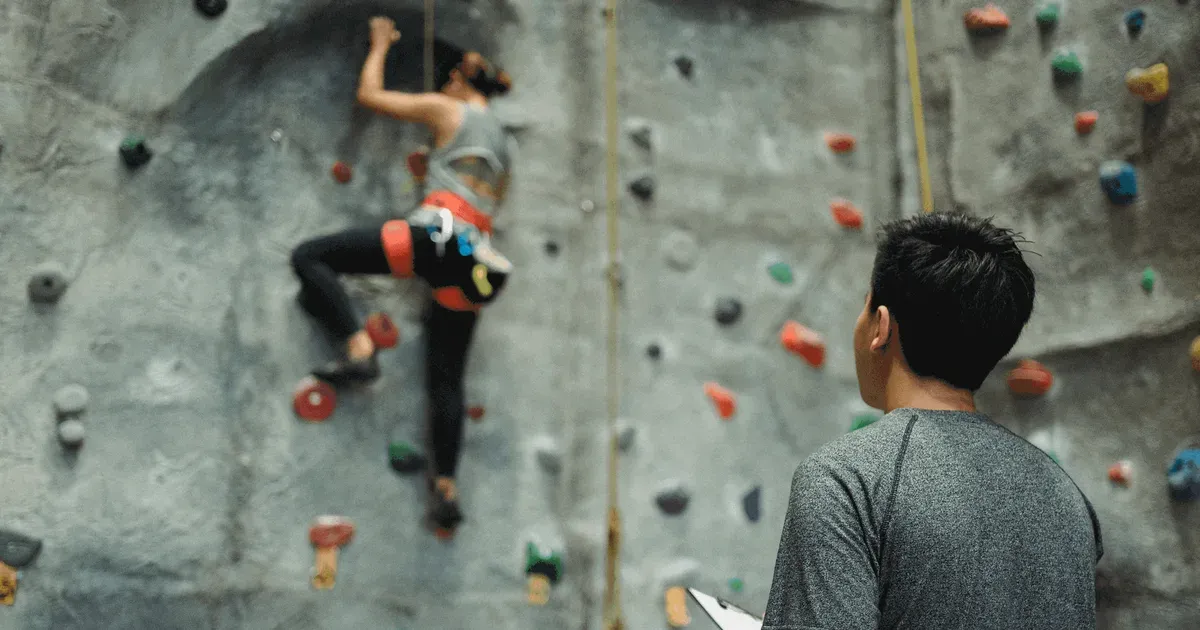
The first session with a new athlete usually fails at one of two extremes.
On one side is the chat: forty minutes talking about goals, nothing written down, and a general feeling that the athlete “has decent fingers but lacks endurance”. Three months later there is no way to tell whether they improved, because there was nothing to compare against.
On the other side is the battery: fifteen tests in two hours, a spreadsheet full of numbers, and an exhausted athlete who has just done max hangs without ever having done them before. Six of those fifteen numbers will never be measured again. The other nine were taken under conditions nobody wrote down, so they can’t be repeated either.
Day one is not about measuring a lot. It’s about setting up a baseline that will still be interpretable a year from now, and deciding whether that athlete is a fit for you. Those are two different jobs, and they’re best kept apart.
The two jobs of first contact
Screening is deciding whether you take the athlete on. It happens before you measure anything, usually on a call, and almost all the information it needs is conversational.
Setting the baseline is producing the data you’ll compare against in three months. It happens once the athlete is accepted, it needs controlled conditions, and its quality depends on protocol far more than on which test you pick.
Mixing them is what produces the two bad sessions above. Try to screen while you measure and you end up with data collected under conversation conditions. Start measuring without screening and sometimes you find out in week four that this athlete was never going to work.
The screening questionnaire
It comes before you accept anyone. Seven questions, and all seven have operational consequences:
- What’s the goal, and when? Without a date there’s no planning, just open-ended generic training. If the athlete has no date, your first job is helping them set one.
- How many days can you actually train? Not how many they’d like. The difference between four and two days changes the kind of plan entirely, and it’s the main source of plans that don’t get done.
- What facilities do you have access to? Gym with a board, weights, a hangboard at home, rock nearby. A plan that assumes equipment the athlete doesn’t have gets abandoned in week two.
- Do you have any pain right now? If there’s active, undiagnosed pain, the right order is refer first, plan second.
- How many years have you been climbing, and how much do you climb now? Accumulated load history matters more than current grade, especially for connective tissue tolerance.
- Have you trained on a plan before? What happened? This is the one that tells you the most. An athlete who has dropped three plans in a row has an adherence problem, not a programming problem, and that’s handled differently.
- What do you expect in terms of communication? If they expect a reply within fifteen minutes at any hour and you answer twice a week, conflict is guaranteed. Better to find out now.
Some answers are a reasonable basis for saying no: a goal that doesn’t match real availability, an active injury no health professional has assessed, an expectation of availability you can’t sustain, or three coaches in one year. Saying no on the call costs five minutes. Saying it in week six costs a lot more, and you usually pay for it in the form of an unhappy athlete who leaves telling their version.
The history that doesn’t expire
Almost everything you measure on day one will be out of date in a few months. Four things won’t:
- Previous injuries: which finger or joint, when, how long it lasted and which movement set it off. It’s the data you’ll look up most often and the worst recorded. Two years on, “had something in the ring finger” is useless.
- Years climbing and grade history. The context that explains why one 7b climber tolerates what another 7b climber can’t.
- Structural constraints. Work, kids, travel, shifts. They change slowly and decide which plans are realistic.
- Documented starting level. Onsight and redpoint, boulder and route, with the style. It’s the real performance result everything else is measured against.
This block isn’t a test battery. It’s a form the athlete fills in once and you’ll look at for years. It deserves to live somewhere proper, not in an email.
How to choose the tests
Before the list, the filter I’d run on any candidate test. Three questions:
- Can I repeat it exactly in twelve weeks? If not, it isn’t a baseline, it’s an anecdote.
- Will I change anything in the plan based on the result? If a number doesn’t change a decision, don’t measure it. You’re creating logging work in exchange for nothing.
- Is it safe to do today, with this athlete? A max test on someone who has never done that movement measures execution, not capacity, and adds risk on day one.
That filter alone removes half of the batteries in circulation.
What makes a reasonable baseline
By category rather than a fixed protocol, because the specific protocol depends on your equipment and your athlete:
- Finger strength, only if the athlete has prior hangboard experience. With edge, grip type and hand recorded next to the number, and normalised to body weight. The specific protocols and how to read them are in finger strength testing protocols.
- Pulling capacity. A simple, repeatable test. What matters is that the variant is fixed: strict pull-ups with a specific grip, not “pull-ups”.
- Some indicator of local endurance. Repeaters to failure, a standardised circuit, whatever you can repeat in your facility.
- Actual climbing level. Onsight and redpoint, boulder and route kept separate, noting the style they move well in. It’s the real performance data.
- Shoulder and elbow. A basic mobility and pain screen. Not to diagnose, but to know whether there’s something to watch and to document it from day one.
- Body weight, and here it pays to be explicit with the athlete: it’s recorded because finger strength is normalised to it, not because it’s a training target. Saying that out loud avoids a fair few problems.
What not to test yet
- Max tests of a movement the athlete hasn’t mastered. You measure test technique, not capacity, and the risk isn’t worth it.
- Anything with active pain. Assess first, measure later.
- Anything you won’t measure again. That’s a good chunk of any long battery.
- More than you have time to do properly. One test done well is worth more than four rushed because the gym is closing.
Protocol matters more than the number
This is the part that decides whether your baseline is any use in three months.
A finger strength number without its conditions can’t be compared with anything. What to fix and record, the same way every time:
- Warm-up, the same one, for the same duration.
- Approximate time of day, and hours since the last session.
- Exact edge and grip type. 20 mm and 18 mm are not two points on the same series.
- Body weight on the day.
- Equipment. Same edge, same surface, same instrument.
The principle: standardise the conditions before chasing instrument precision. An expensive dynamometer measuring under different conditions each time gives worse data than a simple scale measuring the same way every time.
And a warning about interpretation: the first test is usually the worst test. The athlete doesn’t know the movement, can’t pace it, and performs below what they’re capable of. Part of the improvement you see in week twelve will be learning the test, not adaptation. That’s no reason not to measure; it’s a reason not to sell that first improvement as if it were all training.
Common mistakes
- Measuring a lot and recording little. Fifteen numbers without their conditions are fifteen useless numbers.
- Reassessing whenever it comes up instead of on a date. If the reassessment isn’t in the calendar the same day you do the initial one, it won’t happen.
- Changing the protocol between assessments. Switching edges between the initial test and the follow-up breaks the whole series. If you have to change it, test both on the day of the switch.
- Not recording the context of the measurement. The same athlete, tested after two rest days or the day after climbing, gives different numbers.
- Confusing the assessment with the first training session. They’re two things, and sometimes it’s worth splitting them across two days.
Where this breaks
An initial assessment isn’t worth anything for having been done. It’s worth something because you can go back to it.
And that’s the real problem: the baseline gets used three months later, when you close the first block and need to know whether it worked. If by then the numbers are in a spreadsheet, the conditions in your notes, the injury history in an email and the starting level in a WhatsApp message from March, the comparison doesn’t happen. Not because you don’t want to: because rebuilding it takes twenty minutes per athlete and you have fourteen.
With one athlete, you can keep it in your head. With fifteen, the initial assessment turns into a ritual done on day one and never looked at again, which is exactly the waste described in how to coach 20 climbers without drowning in spreadsheets.
What makes a baseline survive is boring: the data lives with the athlete, with its protocol attached, and the reassessment is in the calendar from day one. It’s the same structural requirement you need to quantify training load week by week, and the same one that decides whether your tool actually works for climbing or only for writing plans.
In ClimbrLab every athlete has a profile with injury history, strength measurements with their protocol (hand, grip, edge and body weight on the day) and starting level, available months later without rebuilding anything. Climbing coaching software with early access open.
Keep reading
Quantifying training load in climbing: what to actually use
Climbing has no unit of training load. What each proxy captures (hours, sRPE, moves), why you need two axes, and the weekly minimum that survives February.

How to coach 20 climbers without drowning in spreadsheets
What breaks when a climbing coach goes from 5 to 20 athletes, and how to organise plans, metrics, injuries and communication so the system holds up.
Shoulder and elbow: the climbing injuries you're not watching
The shoulder is now the second most injured area in climbing and almost never gets logged. Why it hides, which sign gives it away and what prevention works.
Do you coach climbing athletes?
ClimbrLab is software for climbing coaches who work with several athletes. You plan sessions and cycles, your athletes log workouts and routes from their app, and you see their finger strength (with Tindeq), training load, injuries and progress in one dashboard, with chat built in. If there are several coaches, Team mode lets you share a library and split athletes between you.
Tell us how you coach and we’ll get back to you with access.