Max hangs vs repeaters: choosing hangboard protocols
What the research says about max hangs, repeaters and minimum-edge hangs, how to pick a protocol for each climber and how to progress it without guesswork.
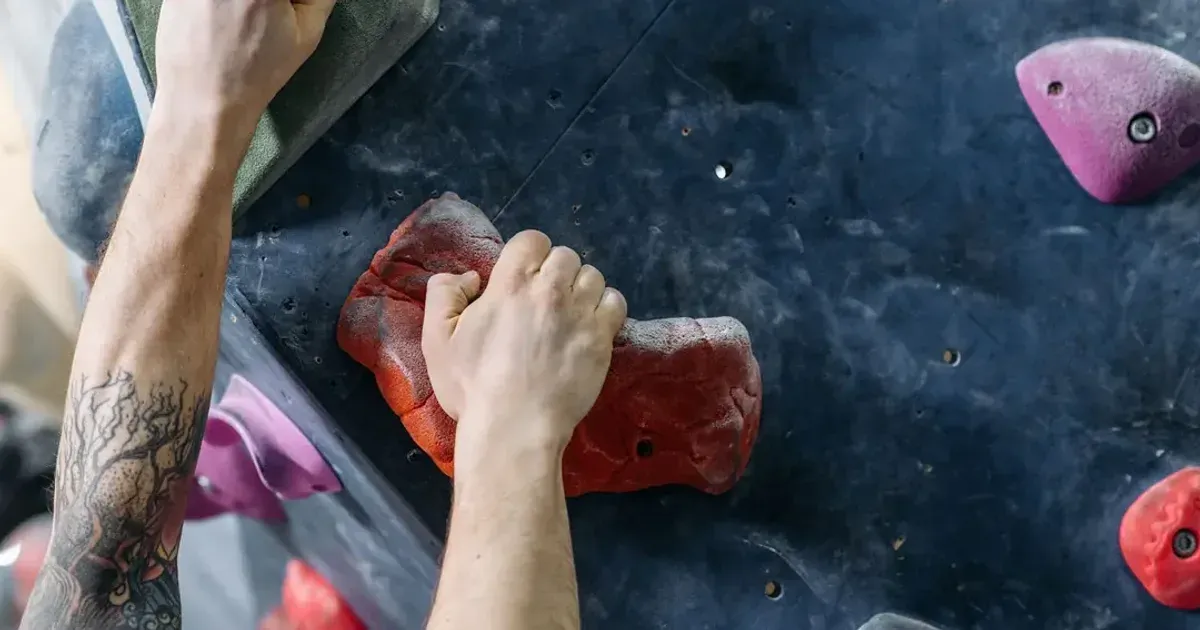
Every climbing coach has had this conversation. An athlete arrives with a screenshot of a hangboard routine from a forum, a video or a friend, and asks whether they should do it. Sometimes it’s max hangs. Sometimes it’s 7:3 repeaters. Sometimes it’s a twenty-minute “finger workout” that mixes both and adds a few one-arm hangs for good measure.
The honest answer is almost never “yes” or “no”. It’s “it depends what you’re trying to change, and what this athlete’s fingers can tolerate right now”. Hangboard protocols aren’t interchangeable recipes. They’re different doses of the same stimulus, and they produce different adaptations.
This article is about choosing between them for a specific athlete, progressing them sensibly, and knowing whether they worked.
Why the protocol matters
A hangboard isolates the fingers. That’s its whole point: you remove footwork, body position and route reading, and you load the finger flexors and their connective tissue in a measurable way. But “load the fingers” can mean very different things:
- Short, near-maximal hangs mainly target maximal force: how hard the athlete can pull on a small edge for a few seconds.
- Repeated submaximal hangs with short rests target the ability to keep producing force over time, which is what route climbers feel as getting pumped.
- Long, low-intensity hangs sit closer to tissue conditioning and rehab than to performance.
The same board, the same edge and the same athlete can end up with very different adaptations depending on the hang time, the rest, the load and the number of sets. That’s why “just hang” isn’t a plan.
What the research actually says
The most cited work on hangboard protocols in climbers comes from Eva López-Rivera and Juan José González-Badillo.
In a 2019 study in the Journal of Human Kinetics, they took 26 advanced sport climbers (mean level around 7c+/8a) and randomly split them into three groups for eight weeks:
- MaxHangs: 10-second hangs on an 18 mm edge with added weight, chosen so the athlete could have held about three seconds longer. Three to five sets, three minutes’ rest between sets.
- IntHangs (what most climbers call repeaters): sets of four 10-second hangs with 5 seconds’ rest between them and a minute between sets, on smaller edges and at body weight.
- A combination of the two.
The outcome they measured was grip endurance. After eight weeks, the endurance gains were about 34% for MaxHangs, 45% for IntHangs and 7% for the combination. The intermittent group improved earlier, already showing significant gains after four weeks. The authors concluded that repeaters seemed more effective for grip endurance, and suggested that both methods could be alternated over longer periods rather than mixed in the same block.
Two things are worth stressing for coaches:
- Max hangs also improved endurance. Getting stronger raises the ceiling, so every submaximal effort costs a smaller percentage of it.
- The combined group did worst. Doing a bit of everything in the same block was the least effective option. That’s a direct argument against the “finger workout that mixes both” your athlete found online.
Earlier work by the same group had compared adding weight on a bigger edge with hanging at body weight on progressively smaller edges. In those experienced climbers, both approaches worked, but adding load on a comfortable edge was at least as effective and is far easier to progress precisely: you change a number on the scale instead of guessing between a 12 mm and a 10 mm edge.
More recently, a 2022 randomised trial in Frontiers in Sports and Active Living with 35 intermediate-to-advanced climbers found that ten weeks of hangboard training increased peak and average finger force more than in a control group that kept climbing normally. It didn’t find a difference in rate of force development, which is a useful reminder: hangboard training builds force, but speed of force production may need other tools, such as the campus board or limit bouldering.
What the research doesn’t give you is a universal “best” protocol. The studies are small, mostly use advanced climbers, and last weeks rather than seasons. Use them to understand which variable drives which adaptation, not as a copy-paste prescription.
Choosing a protocol for a specific athlete
A practical way to decide is to start from three questions.
1. What limits this athlete right now?
If they fall off hard single moves on small holds, but rarely get pumped, maximal finger strength is the obvious target. If they climb the crux of a route fine when fresh but fall off the same holds at the top, endurance and recovery between efforts matter more. Your initial assessment and a dynamometer test should answer this before you write a single hang.
2. What is their training age on the board?
- New to hangboarding: no max hangs yet. Start with submaximal hangs on a comfortable edge, with feet assisted or at body weight, focused on consistent grip position. Many coaches use a simple rule of thumb of at least a year or two of regular climbing before structured hangboard work, although there’s no hard cut-off in the literature.
- Some experience: repeaters or submaximal hangs with progressive load.
- Experienced and healthy: max hangs with added weight, alternated with repeater blocks across the season.
3. Where are they in the season?
A strength block before a bouldering season looks very different from the eight weeks before a route trip. The hangboard protocol should follow the season plan, not the other way round.
Practical templates
These are starting points, not validated protocols. Adjust to the athlete in front of you.
Max hangs (maximal strength)
- Edge: 18 to 20 mm, half crimp or open hand, the same grip every session.
- Hang: 10 seconds, with a load the athlete could hold for about 13.
- Sets: 3 to 5, with 3 minutes’ rest.
- Frequency: twice a week is common, rarely more.
- Progression: add 1 to 2 kg when all sets feel comfortably within the margin.
Repeaters (strength endurance)
- Edge: medium to small, at body weight or with a light load.
- Structure: 4 to 6 hangs of 7 to 10 seconds, with 3 to 5 seconds’ rest, forming one set.
- Sets: 3 to 6, with 1 to 3 minutes’ rest between sets.
- Progression: more sets before more load, and more load before smaller edges.
Low-intensity hangs (tissue tolerance)
Long, easy hangs at a low percentage of maximum have become popular as a way to load tendons without high strain. The rationale is plausible, and they can be useful in a return-to-climbing process, but the evidence in climbers is still thin. If you use them, treat them as a complement, and coordinate with a physiotherapist if there’s an ongoing finger injury.
Progressing without guesswork
The most common hangboard mistake isn’t choosing the “wrong” protocol. It’s progressing it by feel and losing track of what the athlete actually did.
A few rules that hold up:
- Change one variable at a time. Load, edge depth, hang time, rest or sets. Change two and you can’t tell which one hurt or helped.
- Keep the grip constant. A half crimp one week and an open hand the next is two different exercises.
- Use a margin, not failure. Hanging to failure every set adds fatigue and risk without obvious extra benefit. The “three seconds in reserve” margin in the López-Rivera protocol is easy to teach.
- Retest at the end of each block. The same test, on the same edge, at the same time of day.
- Plan the deload. After a demanding block of max hangs, a deload week that keeps intensity and cuts volume protects the gains.
Hangboard and climbing in the same week
The hangboard doesn’t sit in a vacuum. The same fingers are doing board sessions, limit bouldering and weekend projecting. A max hang session on Tuesday followed by two hours of board climbing on Wednesday is a lot of high-intensity finger load in 48 hours.
Some practical guidelines:
- Hangboard first, fresh. If it shares a session with climbing, put it after the warm-up and before anything hard.
- Count it in the weekly load. If you quantify training load with a finger-specific axis, hangboard sets belong there, not in a separate “supplementary” bucket.
- Don’t add hangs on top of a full climbing week. Replace some hard climbing with hangboard work instead.
Common mistakes
- Mixing max hangs and repeaters in every session. In the López-Rivera study, the combination group improved least.
- Adding load on feel. Without a log, athletes either stall or jump too fast.
- Changing edges between sessions. Different boards, different edge depths, different results.
- Starting beginners on max hangs. Climbing itself is still the best finger training for them.
- Training through finger pain. Discomfort that lingers after the session is a signal to adjust, not to push.
- Never retesting. If you don’t measure at the end of the block, you don’t know whether the protocol did its job.
Frequently asked questions
Are max hangs or repeaters better for climbing?
They target different things. In a 2019 study of 26 advanced sport climbers, eight weeks of repeaters improved grip endurance by about 45% and max hangs by about 34%, while combining both in the same block improved it by only 7%. Max hangs are the usual choice for maximal finger strength, repeaters for strength endurance, and alternating them across blocks is a sensible approach.
How often should climbers hangboard?
Most structured protocols use two sessions a week, with at least 48 hours between hard finger sessions. The right number depends on how much hard climbing the athlete is doing at the same time, because the board and the hangboard load the same tissues.
When can a climber start hangboard training?
There is no fixed threshold in the research. Many coaches wait until a climber has a year or two of consistent climbing and starts with submaximal hangs on a comfortable edge before adding weight. Younger athletes in growth periods need extra caution.
Should hangboard hangs be done to failure?
Usually not. Protocols like López-Rivera’s MaxHangs use a load the climber could hold for about three seconds longer than the prescribed hang. Leaving a margin keeps quality high and reduces the risk of overloading the fingers.
How can a coach track hangboard progress for several athletes?
By logging each athlete’s protocol, edge, grip, load and sets, and retesting at the end of each block. ClimbrLab is climbing coaching software that keeps per-athlete plans, session logs and finger-strength tests in one place.
Where this breaks
With one athlete, keeping track of hangboard progress is easy: you watch the session, you note the load and you know which edge they used. With fifteen athletes, half of them training on their own at different gyms, it falls apart.
One athlete says they hung “with 10 kg” but doesn’t remember on which edge. Another switched from half crimp to open hand two weeks ago and their numbers dropped, so they think they’ve lost strength. A third is doing max hangs and repeaters in the same session because that’s what the video showed. And none of it is written down in the same place as their climbing load, so nobody notices that their finger volume doubled the week before their pulley started complaining. It’s the same problem we described in coaching 20 climbers without drowning in spreadsheets.
How this works in ClimbrLab
ClimbrLab is the tool we’re building for climbing coaches who work with several athletes at once, and hangboard training is one of the places where a precise prescription matters more than a motivating one.
With ClimbrLab
You prescribe hangboard work as an exercise with its own parameters: hang time, rest, sets, edge and load. The athlete sees exactly what to do on their phone, and logs what they actually did:
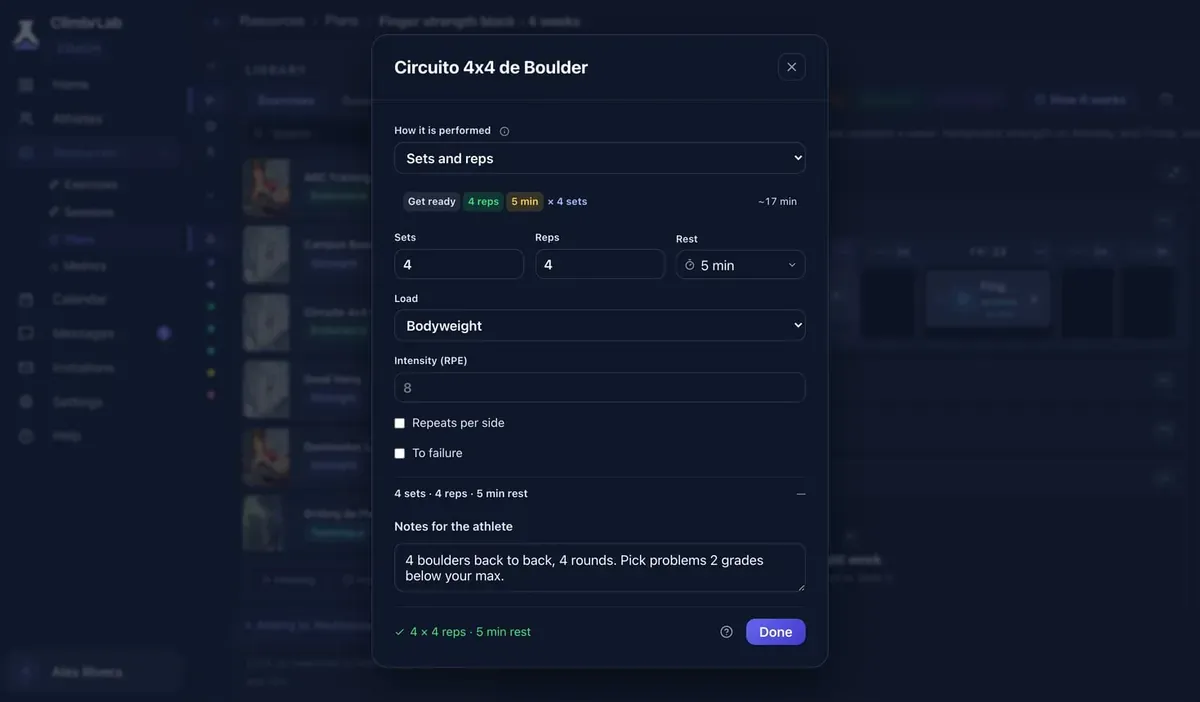
Repeaters, max hangs and low-intensity hangs become different exercises, and you can alternate them across blocks instead of mixing them in a single session.
- Block-based plans, one per athlete. A max hang block for one athlete and a repeater block for another, side by side.
- A session log on the athlete’s phone. Load, RPE and discomfort after every session, so progression is based on data, not memory.
- Finger-strength tests per hand in each athlete’s history, to check whether a block actually worked.
- Injury history with side and area, so a finger complaint is logged the day it appears.
We’re opening early access for coaches. If you prescribe hangboard work to several athletes, leave us your details and we’ll let you know.
Keep reading
Board climbing in a training plan: how to prescribe it
MoonBoard, Kilter or Tension: how to write a board session an athlete can follow, which variables to fix, how to cap finger load and what to log each time.
Monitoring climber readiness: wellness checks and HRV
What research says about wellness questionnaires and heart rate variability, which one a climbing coach should use, and how to turn daily check-ins into decisions.
Fuelling climbers: what a coach should know about nutrition
What research says about carbohydrate, protein and weight in climbing, the warning signs to notice, and where a coach’s role ends and a dietitian’s begins.
Do you coach climbing athletes?
ClimbrLab is software for climbing coaches who work with several athletes. You plan sessions and cycles, your athletes log workouts and routes from their app, and you see their finger strength (with Tindeq), training load, injuries and progress in one dashboard, with chat built in. If there are several coaches, Team mode lets you share a library and split athletes between you.
Tell us how you coach and we’ll get back to you with access.