Board climbing in a training plan: how to prescribe it
MoonBoard, Kilter or Tension: how to write a board session an athlete can follow, which variables to fix, how to cap finger load and what to log each time.
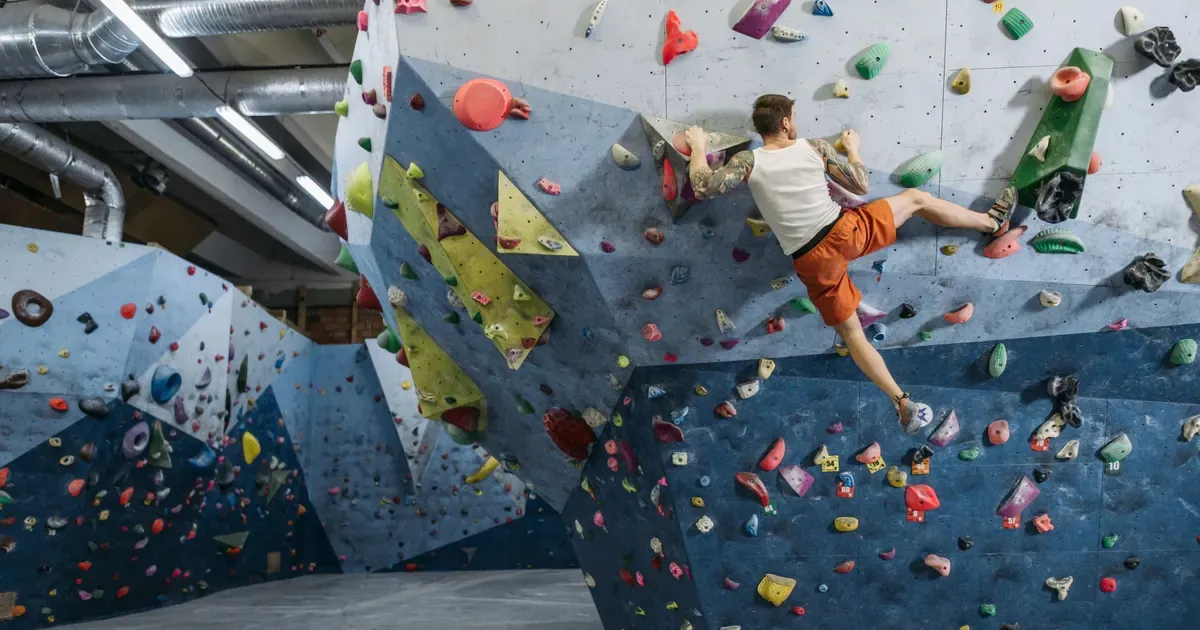
Most coaches prescribe board climbing the same way: “Board session, 1h30.” Then the athlete goes to the gym, opens the app, scrolls for something that looks fun, tries a problem two grades above their max fifteen times, tweaks a finger and tells you it was a great session.
The irony is that the board is the most measurable thing a climber does all week. Fixed holds, fixed angle, named problems with grades that don’t get reset every six weeks. It’s the only climbing session that can be repeated exactly a month later. Prescribed that loosely, you throw away the one thing that makes it valuable.
This article is about writing board sessions properly: what to fix, how to dose them, and what to get back from the athlete.
Why the board is different from the gym wall
A commercial gym wall is a moving target. Problems get reset, grades drift between setters, and “V6 in October” and “V6 in December” aren’t the same thing. You can’t measure progress on a wall that changes under the athlete.
A standardised board solves that:
- The same problem exists for months or years, so repeats are true repeats.
- The angle is fixed or controllable, so steepness doesn’t become a hidden variable.
- Benchmarks exist. Most board apps flag a set of problems with consensus grades that work as a test battery.
- Mirrored layouts, on boards that have them, let you check left/right asymmetries on the same problem.
It also has a cost. Board holds are small and the walls are steep, so a board session is almost always a high-intensity finger day, with a lot of crimping and significant shoulder load in compression and lock-offs. Treat it like hangboard work in terms of load, not like a fun bouldering session.
The variables a board session needs
A board session written as “board, 90 minutes” leaves all the decisions to the athlete. These are the ones you should make:
- Board and angle. “Kilter at 40°” and “Kilter at 50°” are different sessions. On adjustable boards, keep the angle constant inside a block, or progression becomes impossible to read.
- Problem set. Benchmarks, a list you choose, or free choice inside a grade band. Each has a purpose.
- Grade band, relative to the athlete’s board max. Not their gym grade and not their rock grade. A climber who sends 7C outside might be a 7A climber on a MoonBoard, and that’s normal.
- Attempts per problem and total attempts. This is the real load variable, more than session length.
- Rest between attempts. For limit work, long: three minutes or more. Most athletes rest ninety seconds and call it limit bouldering.
- Stop rule. When the session ends, decided before it starts.
Four session formats worth prescribing
1. Limit session. Three to five problems at or just above the athlete’s board max. Four to six good attempts each, full rest, done when quality drops. This is a strength and power stimulus, and the stop rule matters more than the problem list. A good one: stop when you fail a move you had already done twice in the session.
2. Volume session. Many problems two or three grades below board max, one or two attempts each, short rests. The goal is movement repertoire on small holds and tissue tolerance. Cap the total, for example at twenty-five to thirty problems, because “volume” on a board adds up faster than it feels.
3. Benchmark test. A fixed list of eight to twelve benchmarks across the athlete’s range, repeated every four to six weeks, same angle, same warm-up, same order. Log sends and attempts. It won’t replace a dynamometer test, but it measures something a dynamometer doesn’t: applied strength in climbing movement.
4. Board 4x4 or intervals. Four problems below max climbed back to back, four rounds, with a fixed rest between rounds. Useful as power endurance for boulderers, brutal on fingers, and it belongs in a specific block, not every week.
Pick the format for the block, not for the day’s mood. In a strength block, limit sessions; in a base block, volume; at the start and end of every block, the benchmark.
How much board is too much
There’s no published dose-response for board climbing. What we can say is the same thing we say for any high-intensity finger work: the jump in load is what hurts people, more than the absolute amount.
Some working rules:
- One or two board sessions a week is enough for most intermediate and advanced climbers. Three is a specific block for an athlete with a long history on boards, not a default.
- Count a board session as a finger-intensity day. Don’t stack it on the same day as max hangs unless that’s the plan, and don’t put it the day after either.
- Introduce it like a new exercise. An athlete who’s never trained on a board starts with volume sessions well below max for a few weeks, not with limit sessions.
- Watch the shoulder as well as the fingers. Steep boards put the shoulder in compression and deep lock-offs under load. Shoulder complaints in board-heavy climbers are common and almost never get logged.
- Youth climbers are a separate conversation. Steep crimpy boards and a growing finger don’t mix well, and the default for adolescents should be much more conservative.
If you’re already quantifying training load, log board attempts in your finger axis, not just session minutes. Ninety minutes of chatting between six attempts and ninety minutes of continuous limit attempts have nothing in common.
What to log after each session
The board apps keep a logbook, but that logbook lives in the athlete’s phone, in a third-party app, and you usually never see it. What you need back, every time:
- Board and angle.
- Format (limit, volume, benchmark, intervals).
- Problems tried, with name and grade.
- Attempts per problem and whether it was sent.
- Session RPE.
- Finger or shoulder discomfort, with side. One line, even when it’s nothing.
The format matters more than it seems. “Three problems, no sends” means one thing in a limit session (could be a great session) and something else entirely in a volume session (the grade band was wrong, or the athlete was tired).
Common mistakes
- Prescribing time instead of attempts. Time doesn’t measure load on a board. Attempts do.
- Comparing board grades to gym or rock grades. Different scales. Compare the athlete with themselves on the same board and angle.
- Changing the angle every session. Progress becomes unreadable.
- Short rests in “limit” sessions. If the athlete rests ninety seconds, it’s power endurance, whatever the plan says.
- No stop rule. The last ten attempts of a long session carry the most risk and the least benefit.
- Never retesting. Without benchmarks at the start and end of a block, you don’t know whether the board block worked.
Frequently asked questions
How often should you train on a MoonBoard or Kilter Board?
One or two board sessions a week is enough for most intermediate and advanced climbers. Treat each one as a high-intensity finger day, and don’t stack it on the same day as max hangs or the day after. Three sessions a week is a specific block for athletes with a long history on boards.
How long should you rest between attempts on a board?
For limit bouldering, three minutes or more between attempts. With ninety seconds of rest, a “limit” session turns into power endurance, whatever the plan says.
Are board grades comparable to gym or outdoor grades?
No. Board grades are their own scale, and they also change with the angle on adjustable boards. Compare an athlete with themselves on the same board at the same angle, not with their gym or rock grade.
How do you test progress on a training board?
Pick eight to twelve benchmark problems across the athlete’s range and repeat the same list every four to six weeks, at the same angle, with the same warm-up and in the same order. Log sends and attempts per problem.
How can a climbing coach track board sessions for several athletes?
By prescribing the variables (board, angle, format, attempts, rest, stop rule) and getting the log back in the same structure after every session. ClimbrLab is climbing coaching software built for this: exercises prescribed with sets, reps, rest, load and RPE, a session log on the athlete’s phone, and finger-strength metrics in the same history.
Where this breaks
On paper, this is easy. With one athlete, you ask after every session and remember the answers.
With fifteen athletes, the board data is scattered across fifteen phones and three different apps, half of it never reaches you, and the part that does arrives as a screenshot in a chat. The benchmark you prescribed in September is in one place, the one from November is in another, and nobody lines them up. The single most measurable session of the week ends up being the one with the least data in your system.
The fix isn’t more discipline from the athlete. It’s making the prescription carry the variables (board, angle, format, attempts, stop rule) and making the log come back in the same structure, so the September and November benchmarks sit next to each other without you rebuilding anything.
How this works in ClimbrLab
ClimbrLab is the tool we’re building for climbing coaches who work with several athletes at once, and the board session is a good example of why prescription needs structure, not a notes field.
With ClimbrLab
Every exercise is prescribed with how it’s performed: sets, reps, rest, load, target RPE and notes for the athlete. A board 4x4 stops being “board, 90 minutes” and becomes something the athlete can follow and you can compare:
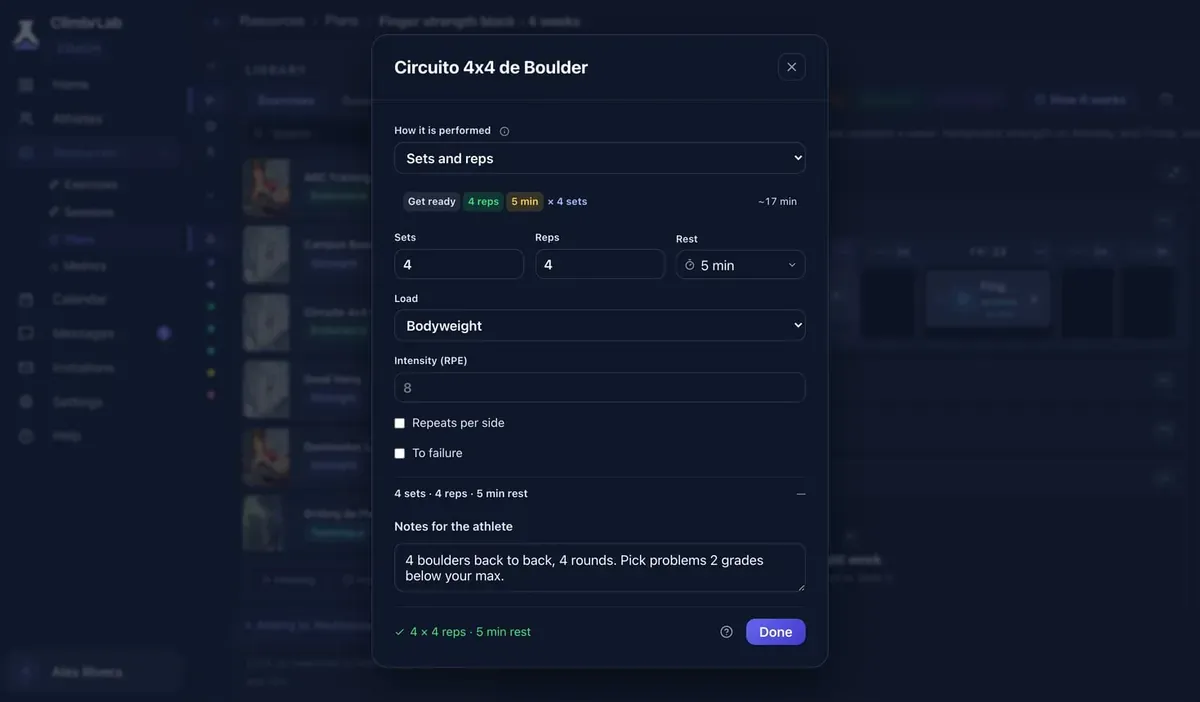
Board and angle go in the athlete’s notes, and the same exercise is reused in every block, so the benchmark you set in September is the same one the athlete repeats in November.
- Sessions and plans you reuse. Build a limit, volume or benchmark board session once and drop it into any athlete’s block.
- A log on the athlete’s phone. Effort, duration, notes and discomfort come back after every session, in the same place as the prescription.
- Finger metrics next to the board. Dynamometer tests per hand sit in the same history, so you can see whether board strength and measured strength move together.
- Injury history with side and area, including the shoulder complaints board-heavy climbers rarely mention.
We’re opening early access for coaches. If your athletes train on boards, leave us your details and we’ll let you know.
Keep reading
Max hangs vs repeaters: choosing hangboard protocols
What the research says about max hangs, repeaters and minimum-edge hangs, how to pick a protocol for each climber and how to progress it without guesswork.
Initial assessment of a climber: what to measure on day one
The screening questionnaire before taking on an athlete, which tests make a useful baseline, what not to test yet, and why protocol beats the number.
Quantifying training load in climbing: what to actually use
Climbing has no unit of training load. What each proxy captures (hours, sRPE, moves), why you need two axes, and the weekly minimum that survives February.
Do you coach climbing athletes?
ClimbrLab is software for climbing coaches who work with several athletes. You plan sessions and cycles, your athletes log workouts and routes from their app, and you see their finger strength (with Tindeq), training load, injuries and progress in one dashboard, with chat built in. If there are several coaches, Team mode lets you share a library and split athletes between you.
Tell us how you coach and we’ll get back to you with access.