Deload weeks in climbing: when and how to program them
What the evidence actually says about deloading, how to cut volume without losing strength, and how to schedule deloads for climbers on different plans.
Ask ten climbing coaches how they program deloads and you’ll get some version of the same answer: “every fourth week, I drop the volume.” Ask them why every fourth week and most of them will shrug. It’s what they were taught, it’s what the plan templates do, and it seems to work.
That’s not a bad place to be. But a deload written into a template on autopilot fails in two predictable ways: it arrives a week too late for the athlete who’s already cooked, and a week too early for the athlete who was finally adapting. And with a group, the athletes who need it least are usually the ones who take it most seriously.
This article is about what deloading actually is, what the evidence does and doesn’t say, and how to schedule it for a roster rather than for an average athlete.
What a deload is (and what it isn’t)
The most useful definition comes from a 2023 Delphi consensus by Bell and colleagues in Sports Medicine - Open. They surveyed expert strength and physique coaches over three rounds and arrived at a working definition: a period of reduced training stress designed to mitigate physiological and psychological fatigue, promote recovery, and enhance preparedness for subsequent training.
Three things stand out in that definition, and all of them matter for climbing:
- Reduced training stress, not zero training. A deload is not a holiday. Complete rest is a different tool with a different purpose.
- Physiological and psychological fatigue. Motivation and mental freshness count as much as tired fingers.
- Preparedness for what comes next. A deload is defined by the block that follows it. It’s a run-up, not a pause.
The same paper is also honest about its limits: deloading is described as ubiquitous but under-researched. Nearly everyone does it; very few studies have tested how to do it.
What the evidence says, briefly
The best direct test so far is a study by Coleman and colleagues (2024, PeerJ). Thirty-nine trained adults followed a nine-week high-volume resistance programme. One group trained continuously; the other stopped training completely for one week at the midpoint.
The results are more interesting than “deloads work”:
- Muscle size, local endurance and power improved similarly in both groups.
- Lower-body strength improved more in the group that kept training.
- The continuous group also scored slightly better on a readiness-to-train questionnaire.
Two caveats before you draw climbing conclusions. First, the “deload” in that study was a full week off, which is closer to detraining than to how most coaches deload. Second, it’s leg strength in gym-goers, not finger strength in climbers. But the direction is useful: a week of complete rest in the middle of a block didn’t buy anything, and cost a bit of strength.
That’s consistent with the much larger literature on tapering. The meta-analysis by Bosquet and colleagues (2007) found that the best results come from cutting volume substantially while keeping intensity, which is exactly the opposite of what many climbers do when they “take it easy.”
For climbing specifically, there’s no good study on deload frequency or structure. What follows is a synthesis of the general principles applied to the sport’s constraints, not a validated protocol.
The climbing-specific problem: tissues recover at different speeds
Most deload advice comes from sports where the main limiter is muscle or the cardiovascular system. Climbing adds a complication: fingers and pulleys adapt and recover much more slowly than muscles do.
That has two practical consequences:
- An athlete can feel fresh before their fingers are. Forearms and motivation bounce back in three or four days. Connective tissue doesn’t. A deload that ends when the athlete “feels good” can send them back into max hangs with tissue that’s still behind.
- Volume is the variable to cut, especially on small holds. Number of hard attempts, time under tension on crimps, total board problems. Those are the inputs that load the fingers most, and those are what a climbing deload should shrink.
If you already quantify training load on a finger axis as well as a session-RPE axis, a deload should show up clearly on the finger axis. If it only shows up as “shorter sessions,” it probably didn’t do much for the fingers.
How to build a deload week
A practical template for a climber coming off a hard strength or power block:
- Volume down 40 to 60%. Fewer sessions is one way, shorter sessions another; fewer hard efforts per session is usually best.
- Intensity kept, or close to it. Hangs stay at a similar load, just fewer sets. Boulders stay hard, just fewer attempts. This is what protects the adaptations.
- Frequency kept, or reduced by one. An athlete who trains four days drops to three, not to one.
- Swap, don’t just subtract. Mobility, easy volume on big holds, antagonist work and technique drills keep the habit without adding finger stress.
- Outdoor days count. A “deload” that ends with a Saturday of projecting on rock isn’t a deload. Plan the weekend as part of the week.
What to avoid:
- Turning the deload into a test week. Max tests at the end of a deload are fine. Max tests every day of the deload are just another hard week.
- Dropping intensity and volume together for more than a week, unless the athlete actually needs a break.
- Letting the athlete fill the gap. The climbers who most need a deload are often the ones who go to the gym “just to climb a bit” and end up on the board for two hours.
Fixed or flexible: when to schedule it
There are two broad approaches, and the Delphi panel’s coaches used both:
Pre-planned deloads. Every third, fourth or fifth week, depending on the block. They’re predictable, easy to communicate and make the plan easier to follow. They work well for athletes who train consistently and for blocks where the load progression is steep, such as a strength block with weekly load increases.
Autoregulated deloads. Triggered by signals rather than by the calendar: performance dropping across sessions, persistent soreness or finger niggles, RPE climbing for the same work, poor sleep, falling motivation. They fit athletes whose lives are irregular, which in practice is most amateur climbers.
What works best for a group is usually a mix: a planned deload at the end of each block as the default, with clear rules for pulling it forward. For example:
- Two consecutive sessions where the athlete can’t hit the prescribed loads.
- Session RPE up by two points for the same session over two weeks.
- A new finger or shoulder complaint, even a mild one.
- A big life stressor: exams, a work deadline, a newborn, poor sleep for more than a few nights.
And clear rules for skipping it: if the athlete missed half the block through illness or travel, they don’t need a deload at the end. They need to finish the block.
Deloads around trips and competitions
The calendar changes everything. A few situations coaches run into every season:
- Before a climbing trip. The deload before ten days on rock is really a taper: cut volume in the final week to ten days, keep a little intensity, arrive fresh. We covered this in detail in preparing an athlete for a climbing trip.
- After a climbing trip. This is the deload nobody plans. Ten days on rock is often the hardest block of the year, and the athlete comes back expecting to jump straight into the next block. The week after the trip should be a deload by default.
- Around competitions. A taper before an A-priority competition replaces the deload; a C-priority competition can sit inside a normal training week.
- Seasonal transitions. The end of the outdoor season and the move back to indoor strength work is a natural point for a longer, lighter week or two.
What to log so you know if it worked
A deload only tells you something if you compare what happens before and after. The minimum:
- The week itself, marked as a deload in the plan, not just as “lighter week” in a note.
- Session RPE and duration during the deload, to check it actually was lighter.
- A reference session before and after. The same hang protocol, a benchmark board circuit, or a dynamometer test. If performance is the same or better after the deload, it did its job.
- Discomfort and sleep. Did the niggle that triggered the deload actually settle?
- Why it happened: planned, or pulled forward, and by which signal. Over a season, this tells you which athletes need more frequent deloads and which ones don’t.
Common mistakes
- Deloading by the calendar only. Every fourth week for everyone ignores who actually needs it.
- Confusing a deload with a week off. Complete rest in the middle of a block is a different tool, and probably not the one you need.
- Cutting intensity instead of volume. Keep the hard sets, just fewer of them.
- Ignoring the weekend. Rock days are part of the load, whether they’re in the plan or not.
- No deload after a trip. It’s the most needed one of the year and the one most often skipped.
- Never checking whether it worked. Without a reference session before and after, a deload is just a quieter week.
Frequently asked questions
How often should climbers take a deload week?
There’s no climbing-specific study that sets a frequency. Most coaches plan one at the end of each three- to five-week block, then pull it forward when signals appear: performance dropping for two sessions, session RPE rising for the same work, a new finger complaint, or poor sleep. Athletes with irregular schedules often need fewer planned deloads, because life already gives them lighter weeks.
What should a climbing deload week look like?
Cut volume by roughly 40 to 60%, keep intensity close to normal and keep most of the training frequency. In practice that means fewer hard attempts and hang sets, not easier ones, plus mobility, easy climbing on big holds and technique work. Outdoor days at the weekend count as part of the load.
Is a full week off better than a deload?
Not in the middle of a training block. In a 2024 study by Coleman and colleagues, a full week off at the midpoint of a nine-week programme didn’t improve muscle size, endurance or power and led to smaller strength gains than continuous training. A complete break has its place at the end of a season or for an athlete who needs a mental reset.
Do fingers need longer to recover than muscles?
Yes. Tendons and pulleys adapt and recover more slowly than muscle, so a climber can feel fresh before their fingers are. That’s why a climbing deload should cut finger-specific volume, such as hard crimping, board attempts and hang sets, and why returning to max finger work should be gradual.
How can a climbing coach manage deloads across several athletes?
By marking each deload as a block in each athlete’s plan, logging session RPE and discomfort, and comparing a reference test before and after. ClimbrLab is climbing coaching software built for that: block-based plans per athlete, a session log on the athlete’s phone and test history in the same place.
Where this breaks
With one athlete, deciding when to deload is easy: you see them, you ask, you adjust. With twenty athletes on different plans, the deload becomes a scheduling problem.
On any given week, three athletes should be deloading because their block ends, one should have deloaded last week but didn’t because of a competition, two just came back from a trip and are about to start a strength block on tired fingers, and one has had rising RPE for a fortnight that nobody noticed because it lives in a chat history. A fixed every-fourth-week rule in a spreadsheet is easy to set up precisely because it doesn’t look at any of that.
How this works in ClimbrLab
ClimbrLab is the tool we’re building for climbing coaches who work with several athletes at once, and deload timing is one of the places where seeing every athlete’s season in one view changes the decision.
With ClimbrLab
Each athlete has a season map where blocks, trips and competitions sit on the same timeline. A deload is a block of its own, so you can see at a glance that the athlete coming back from a trip has one scheduled before the next build:
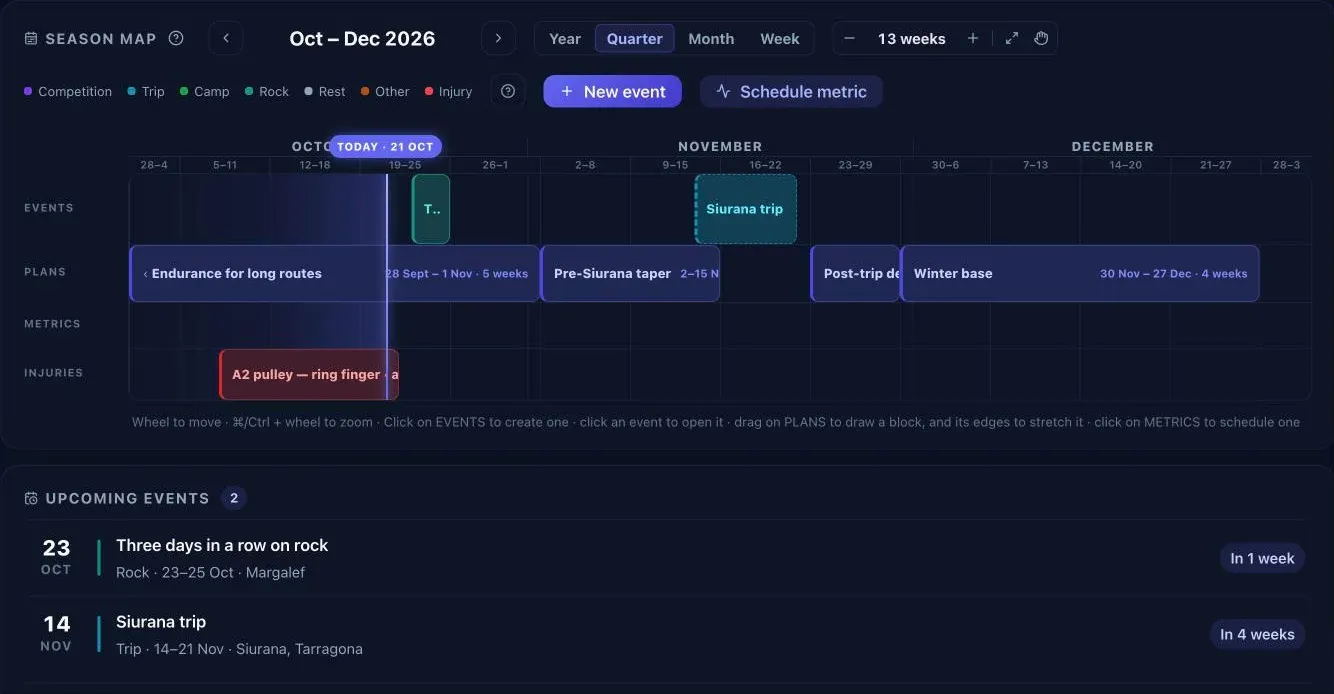
And because the session log comes back with effort and discomfort, the signals that should pull a deload forward are in the same place as the plan.
- Block-based plans, one per athlete. Strength, power, endurance and deload blocks with their sessions, which the athlete follows from the app.
- A session log on the athlete’s phone. RPE, duration, notes and discomfort after every session, including rock days.
- Tests before and after. Finger-strength tests per hand in the athlete’s history, so you can check whether a deload did its job.
- Injury history with side and area, so a new niggle is logged the day it appears.
We’re opening early access for coaches. If you’re juggling deloads across a roster, leave us your details and we’ll let you know.
Keep reading
Climbing trips: how to prepare an athlete for ten days on rock
The four weeks before, the back-to-back tolerance nobody trains, the real curve of a long trip and what to log during the ten days.
Rock climbing seasons in Europe: how they shape your planning
Siurana, Font, Céüse or Rodellar set your athlete's window better than any calendar. How to build a training year backwards from rock conditions.

How to plan a climbing season in mesocycles
A practical guide to structuring a climbing season into mesocycles: how to distribute load, when to train max finger strength and how to peak for your project.
Do you coach climbing athletes?
ClimbrLab is software for climbing coaches who work with several athletes. You plan sessions and cycles, your athletes log workouts and routes from their app, and you see their finger strength (with Tindeq), training load, injuries and progress in one dashboard, with chat built in. If there are several coaches, Team mode lets you share a library and split athletes between you.
Tell us how you coach and we’ll get back to you with access.